Ming Ta Pays Tribute to Antoni Gaudí: Transforming Architectural Art into Wearable Masterpieces.
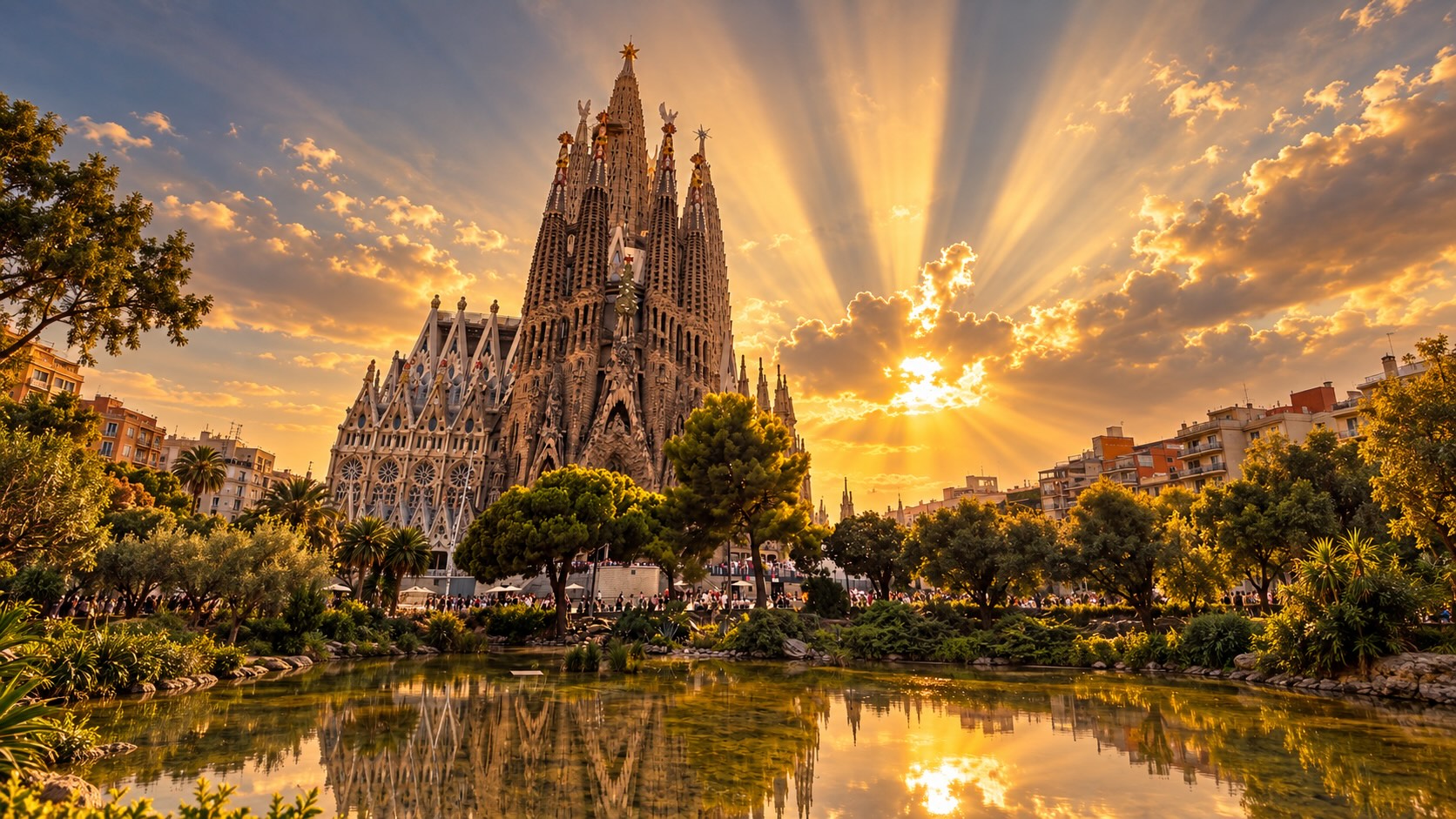
Antoni Gaudí once famously expressed the belief that there are no straight lines in nature. To him, truly great design was not about creating something out of nothing, but about rediscovering and understanding the divine order that God had already established within the natural world.The branches of trees, the geometry of honeycombs, the structural support of bones, the curves of ocean waves, the blossoming of flowers, and even the changing patterns of sunlight filtering through a forest all became essential sources of inspiration for his architectural creations.For this very reason, Gaudí's architecture has never been merely "architecture." Rather, it resembles an extraordinary piece of jewelry magnified to the scale of an entire city.The soaring towers of the Sagrada Família, envisioned in Gaudí's architectural designs, rise like precious gemstones set against the sky. The flowing roof of Casa Batlló resembles the shimmering scales along a dragon's back. The undulating, irregular stone façade of Casa Milà evokes layers of rock shaped by centuries of natural erosion. Meanwhile, the brilliantly colored broken-tile mosaics of Park Güell resemble an enormous jeweled surface composed of colored gemstones, enamel, and intricate mosaic patterns.If we were to reinterpret Gaudí's artistic creations today, transforming them from the monumental scale of architecture into the intimate scale of jewelry, we could establish an exceptionally distinctive and recognizable language of jewelry design.
I. Natural Curves: The Beauty of Jewelry That Appears to Be Alive
The first essential element is the concept of natural curves.Gaudí rarely relied on rigid straight lines. Instead, he favored organic structures that appeared to grow naturally, much like plants and trees.This philosophy can be translated into the silhouettes of rings, brooches, necklaces, and bracelets.For example, a ring setting need not be limited to a conventional circular structure. It could extend organically like the branches of a tree, with the metal prongs becoming delicate stems and the gemstones appearing to grow naturally among them, like fruits or flower buds.Such a design goes beyond conventional decoration.It represents the idea of "Living Jewelry" — jewelry that seems to possess its own vitality, movement, and organic beauty.
II. Trencadís: Transforming Gaudí's Mosaic Art into Gemstone Design
The second element is one of Gaudí's most recognizable artistic techniques: Trencadís, the distinctive mosaic technique created by arranging irregular fragments of broken ceramic tiles.When translated into jewelry design, this artistic language can be expressed through combinations of differently colored sapphires, tsavorites, rubies, yellow diamonds, opals, enamel, and other colored gemstones.These materials can be arranged using irregular gemstone cuts or intricate pavé-setting techniques.Each gemstone does not necessarily need to be identical in size, shape, or proportion. Instead, like Gaudí's mosaics, the individual elements can form a harmonious overall composition through carefully balanced irregularity.What may initially appear random ultimately reveals an underlying artistic order.Ming Ta intends to develop these design elements into distinctive collections of brooches, bracelets, earrings, and artistic high jewelry.Through this approach, the brilliance of precious gemstones can be combined with the expressive freedom of mosaic art, creating jewelry that celebrates individuality while maintaining a unified aesthetic.
III. The Art of Light: From the Sagrada Família to Precious Gemstones
The third element is light, one of the most extraordinary artistic characteristics of the Sagrada Família.Gaudí possessed a profound understanding of how light interacts with architectural space.He did not regard windows merely as openings that allowed daylight to enter a building. Instead, he treated light itself as an essential component of architecture.Inside the Sagrada Família, sunlight passes through magnificent stained-glass windows, transforming into countless shades of blue, red, orange, and green.These colors interact with the architectural structures, creating an atmosphere that feels almost sacred.Jewelry, in many respects, is also an art form devoted to the study and expression of light.Diamonds are fascinating not simply because of their rarity, but because of the extraordinary ways in which they interact with light.Their brilliance, fire, and scintillation emerge through the relationship between light and the gemstone's optical properties.Inspired by Gaudí's approach, jewelry designers can explore the different refractive indices, transparency, and colors of gemstones, allowing light to travel through various materials and create layered visual effects reminiscent of stained-glass windows.For example, a pendant inspired by the rose windows of the Sagrada Família could feature a brilliant diamond at its center, symbolizing the source of light.Surrounding the central diamond, sapphires, rubies, emeralds, and yellow gemstones could be arranged in a radiating composition.The resulting design would express the concept of light expanding outward from a central source.Such a creation would no longer be merely an ornament. It would become a miniature cathedral that can be worn.
IV. The Integration of Architecture and Sculpture: When Structure Becomes Art
Another remarkable aspect of Gaudí's work that deserves particular attention in jewelry design is the integration of architecture and sculpture.In Gaudí's creations, a wall is never simply a wall, and a column is never merely a structural support.Every architectural component may simultaneously serve a functional and symbolic purpose.The same philosophy should be applied to high jewelry.Truly exceptional jewelry design should not be limited to placing gemstones onto precious metal surfaces.Instead, the gemstone-setting structures themselves should become an integral part of the artistic composition.For example, gemstone prongs could be shaped like delicate tree branches.Openwork structures on the reverse side of jewelry could draw inspiration from the vaulted ceilings of the Sagrada Família.Bracelets could incorporate the flowing, wave-like architectural forms of Casa Milà.The side profiles of rings could feature geometric structures inspired by honeycombs, skeletal systems, or plant cells.These design possibilities demonstrate one of the most important lessons modern designers can learn from Gaudí : Function does not need to compromise beauty, and beauty does not need to exist independently of structure.When engineering, craftsmanship, and artistic imagination are thoughtfully integrated, the structural elements of a piece can become part of its most distinctive visual identity.
V. The Renaissance Spirit: Reuniting Art, Science, Nature, and Craftsmanship
If we further incorporate the spirit of the Renaissance, this jewelry collection can acquire an even deeper cultural significance.The true importance of the Renaissance was not simply the revival of classical artistic styles. More fundamentally, it represented a renewed belief in human creativity and the possibility of bringing art, mathematics, nature, science, and craftsmanship together. Leonardo da Vinci studied human anatomy and proportions while simultaneously exploring mechanics, engineering, and scientific invention. Michelangelo was not only a sculptor but also an accomplished architect whose creations transcended the boundaries between artistic disciplines. Centuries later, Gaudí similarly integrated architecture, sculpture, natural forms, biological structures, religious symbolism, and craftsmanship into a unified artistic vision.
The true connection between Gaudí and the Renaissance, therefore, does not lie primarily in outward appearance.
It lies in their shared creative spirit.
It is the belief that art should not be confined by rigid classifications or disciplinary boundaries.
A single piece of jewelry can simultaneously embody sculpture, architecture, engineering, religious symbolism, and personal emotion.
It can be both an object of beauty and a demonstration of structural ingenuity.
It can preserve cultural history while expressing the individual identity and emotional experiences of its wearer.
Through this philosophy, jewelry becomes a meeting point between artistic imagination and technical mastery.
VI. Gaudí Inspired Jewelry Art: Translating Architecture into Wearable Art
As a tribute to this extraordinary master, Ming Ta envisions establishing a collection entitled: "Gaudí Inspired Jewelry Art" The purpose of this collection is to translate the artistic language of architecture into wearable works of art. Rather than merely reproducing famous buildings in miniature, the collection seeks to reinterpret the deeper ideas behind Gaudí's creative philosophy. The Sagrada Família Collection would symbolize faith, light, and hope. Inspired by the cathedral's soaring towers, intricate structures, and magnificent stained-glass windows, this collection would explore the relationship between spiritual symbolism, precious gemstones, and the transformative power of light. The Casa Batlló Collection would draw upon dragon scales, skeletal structures, and flowing ocean-inspired curves. Its jewelry designs could incorporate sculptural metalwork, colorful gemstones, and organic forms that evoke the extraordinary movement and imagination found in Gaudí's architecture. The Park Güell Collection would celebrate colored gemstones and mosaic compositions. Through vibrant gemstone arrangements, enamel craftsmanship, and unconventional setting techniques, the collection would reinterpret the joyful colors and artistic freedom of Gaudí's celebrated mosaics. The Casa Milà Collection would explore the beauty of rocks, waves, and organic curves.Its designs could develop a more minimalist artistic direction, emphasizing sculptural silhouettes, flowing metal surfaces, and the quiet elegance of natural geological forms. Finally, the Tree of Life Collection would transform Gaudí's profound respect for nature into jewelry inspired by plants, branches, leaves, flowers, and precious gemstones. In this collection, the organic beauty of nature would become a symbolic expression of growth, vitality, renewal, and the enduring relationship between humanity and the natural world. Together, these collections would establish a coherent artistic vision while allowing each design to possess its own distinctive identity.
VII. The True Meaning of Paying Tribute to a Master
We believe that art truly worthy of being passed down through generations is never simply about reproducing an existing architectural masterpiece. The deeper purpose is to understand why the original artist created it in that particular way. Perhaps the most important legacy Gaudí left to future generations is not the Sagrada Família itself, but a profound creative philosophy:
To respect nature.
To understand structure.
To believe in craftsmanship.
To approach light with reverence.
And to reconnect art with life.
When these principles are incorporated into jewelry design, jewelry ceases to be merely a symbol of wealth.
It can become a miniature architectural masterpiece, a sculpture worn close to the human body, and an artistic story capable of being treasured and passed down through generations.
Each piece can preserve not only the beauty of precious materials but also the imagination, philosophy, and cultural values that inspired its creation.
VIII. A Tribute to Antoni Gaudí: Celebrating the Sagrada Família in 2026
In 2026, as the Sagrada Família reaches the historic milestone of the completion of its central tower, Ming Ta pays its deepest tribute to Antoni Gaudí and his extraordinary artistic legacy.
We believe that the most meaningful way to reinterpret great art for the next century is not to transform architecture into conventional souvenirs.
Instead, it is to understand the soul of architecture and allow that spirit to become something entirely new.
Our vision is to transform the soul of architecture into wearable works of art — creations that unite nature, craftsmanship, cultural heritage, and the timeless beauty of precious gemstones.
Through this tribute, Ming Ta hopes to carry forward the creative spirit of Antoni Gaudí, allowing his artistic philosophy to inspire new expressions of beauty for generations to come.
Ming Ta — Where Architecture, Nature, and Fine Jewelry Become Art.